When Your Life Looks Stable but Emotionally You're on Airplane Mode
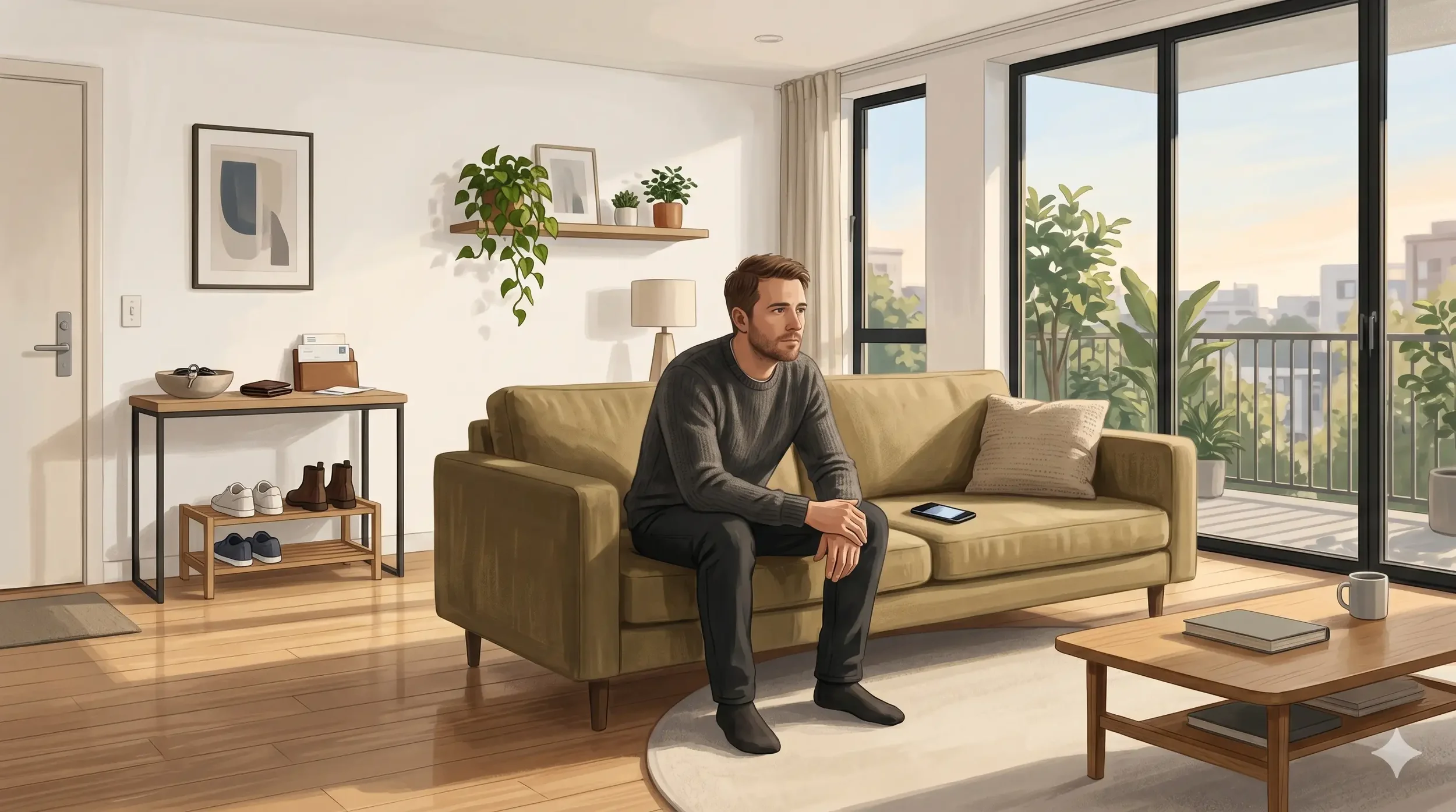
For the ones whose life is technically functioning. Whose calendar is full, obligations are met, and from most angles things look fine. But who have quietly noticed that something inside has gone very still.
There's a specific kind of exhaustion that doesn't show up on the outside.
Your life looks fine. You pay bills, reply to messages, show up to things. You remember the names of people's partners. You ask follow-up questions. You hold a lot together without it visibly falling apart.
From the outside, you look like someone who has it handled.
On the inside, it might feel more accurate to say: you're on airplane mode. Not broken. Not in crisis. Just quietly offline. Present in body, absent somewhere else entirely.
What airplane mode actually looks like
It's not the same as burnout, although it often arrives on its back.
It's not clinical depression, although it can sit in that same neighbourhood.
It's more like an emotional suspension. You're functioning well enough, but the feelings that are supposed to accompany your life have stopped arriving in full. You can describe your week but not really tell anyone how you felt about it. You can plan the next month but not say whether you actually want any of it.
You might recognise it in moments like these:
Someone asks how you are and you say "good, busy" on autopilot. It's technically true and it completely avoids the question, and you both move on.
You do something you've worked hard for and notice you feel... not much. A brief flicker. Then straight back to the list of what's next.
You watch other people get visibly excited or upset about things and feel a strange distance from your own reactions, like you're observing your own life from slightly outside of it.
You can laugh, function, hold conversations, and get through the day. But there's a flatness underneath it all that you're not sure how to explain without sounding dramatic.
A problem to solve feels easier to hold than an emotion to sit with. You gravitate towards tasks the way other people gravitate towards people.
The lights are on. The building is open. But you're not quite home.
How you got here
Airplane mode doesn't usually happen in a single moment. It's rarely the result of one big thing.
More often, it's what happens after a long stretch of keeping it together. Months, sometimes years, of being the one who adapts, manages, absorbs, and keeps moving. Of handling things because they needed to be handled. Of not really having the space, or the person, to put things down in front of.
When feelings are repeatedly not responded to, your nervous system starts to learn something. You share something and get a distracted reply. You reach out and notice nobody actually asks a follow-up question. You bring something real and it gets minimised or redirected. Over time, your system registers the pattern.
It learns that feelings are inconvenient. That they slow you down. That they don't reliably lead anywhere useful.
So gradually, it stops surfacing them as readily.
The shutdown isn't a character flaw. It's an adaptation. Your internal system decided, based on a lot of evidence, that staying on airplane mode was the more efficient setting. You could keep functioning. You could keep being useful. You just couldn't quite feel it.
The particular loneliness of being stable on the outside
One of the quietest things about being in this state is that nobody around you notices.
When you're visibly struggling, people sometimes ask. When you go quiet in obvious ways, concerned messages arrive. But when you're on airplane mode, you're still present enough that nothing looks wrong. You're still reliable, still articulate, still managing. There is no visible signal for the people around you to respond to.
Which means you can spend a significant amount of time carrying something that nobody in your life knows is there.
You might be going through a period of quiet grief, for something you wanted that didn't happen or a version of your life you had to let go of, and still turning up to everything. You might be feeling profoundly disconnected from your relationships while technically maintaining all of them. You might be experiencing a dull heaviness you can't quite name, something that makes ordinary things feel like they require twice the effort, without there being any clear reason you can point to.
You might also be privately wondering whether this is just what adult life feels like for everyone. Whether the flatness is normal. Whether you've somehow forgotten to adjust your expectations.
And because you keep showing up, keep delivering, keep managing, the people around you have very little reason to suspect otherwise.
This is one of the more isolating parts of it. The more capable you appear, the less space others tend to create for the parts of you that are not doing well. You get met with the version of you that's coping, because that's the only version they've been shown.
When handling it becomes the only setting you know
There's a point where managing everything alone stops being a temporary strategy and becomes the default mode you operate from.
You might notice:
Emotional conversations have started to feel effortful in a way they didn't used to. Not because you don't care, but because connecting to your own inner experience in real time feels unfamiliar now.
You've lost touch with what you actually want, separate from what makes practical sense or what you're supposed to want.
You can talk at length about what you're doing, but when someone asks how you're feeling, you have to stop and genuinely search for an honest answer. It doesn't come automatically.
Slowing down comes with a low-level anxiety. Because when you stop running, the things you've been outrunning have a tendency to catch up.
The efficiency that airplane mode offers comes with a cost. And that cost is this: you start experiencing your own life at a distance. You're in it, technically. You're just not quite inhabiting it.
What coming back online actually looks like
It isn't dramatic. It doesn't require a breakdown, a life overhaul, or a sudden revelation.
It usually starts very small. Not with grand statements of vulnerability, but with tiny, almost inconvenient moments of contact with your own interior.
Some of what that might look like in practice:
Letting yourself notice without immediately moving on. When something lands, good or bad, giving it thirty seconds of your attention before reaching for the next task. Not to process it fully. Just to let it register.
Lowering the bar for what counts as a feeling. Airplane mode often means the big emotions have gone quiet, but the smaller ones are still moving. Mild irritation. A brief sadness. A flicker of interest or excitement. Those count. They're not irrelevant just because they're not overwhelming.
Finding one space that isn't about performance. Somewhere you don't have to be useful, capable, or measured. A place where what you bring doesn't need to be impressive, neatly resolved, or presented in a way that makes it comfortable for someone else to receive.
Being honest with yourself about how long you've been offline. Not as a criticism. Just as an acknowledgement. Naming it, even privately, even just to yourself, is often the first thing that shifts it.
If this is where you are right now
If your life is technically stable and you're still feeling strangely distant from it, there is nothing wrong with you for noticing that something is off.
Functioning is not the same as living. Coping is not the same as being okay. And the fact that your outer life is intact doesn't mean your inner experience doesn't deserve attention.
You're allowed to want more than the muted version of your own life.
Unburdora is for exactly this: people who look fine from the outside but have quietly noticed they've been on airplane mode for longer than they'd like. Sessions are a non-clinical, one-to-one space. You don't need to arrive in crisis, prove that something is "bad enough," or have a clear explanation ready.
You can start from something like: "My life looks stable, but I've been emotionally offline for a while, and I'm not sure how to find my way back."
That's enough. We can start from there.