The Cult of the Professional Amateur: Why Modern Mediocrity is Winning (And How to Opt Out)
Have you ever stood in a room, watched a performance, or scrolled through a feed and felt like you were losing your mind?
You’re looking at a specialist who lacks the basic foundations of their craft. You’re watching a creator produce content so mundane it borders on the anesthetic. And yet, the applause is deafening. The likes are pouring in. People are opening their wallets.
If you have a refined eye, a bit of life experience, perhaps you’ve traveled the world or mastered a few languages, this phenomenon feels like a personal affront. It’s a specific kind of competence vertigo. You see the lack of talent, the absence of depth, and the blatant shortcuts, yet the crowd seems perfectly content with the lukewarm burger they’re being served.
For the past several years, we’ve been sliding into a Mediocracy. Here is why it’s happening, and why it’s making the world a very lonely place for people with high standards.
1. The Arbitrage of "Good Enough"
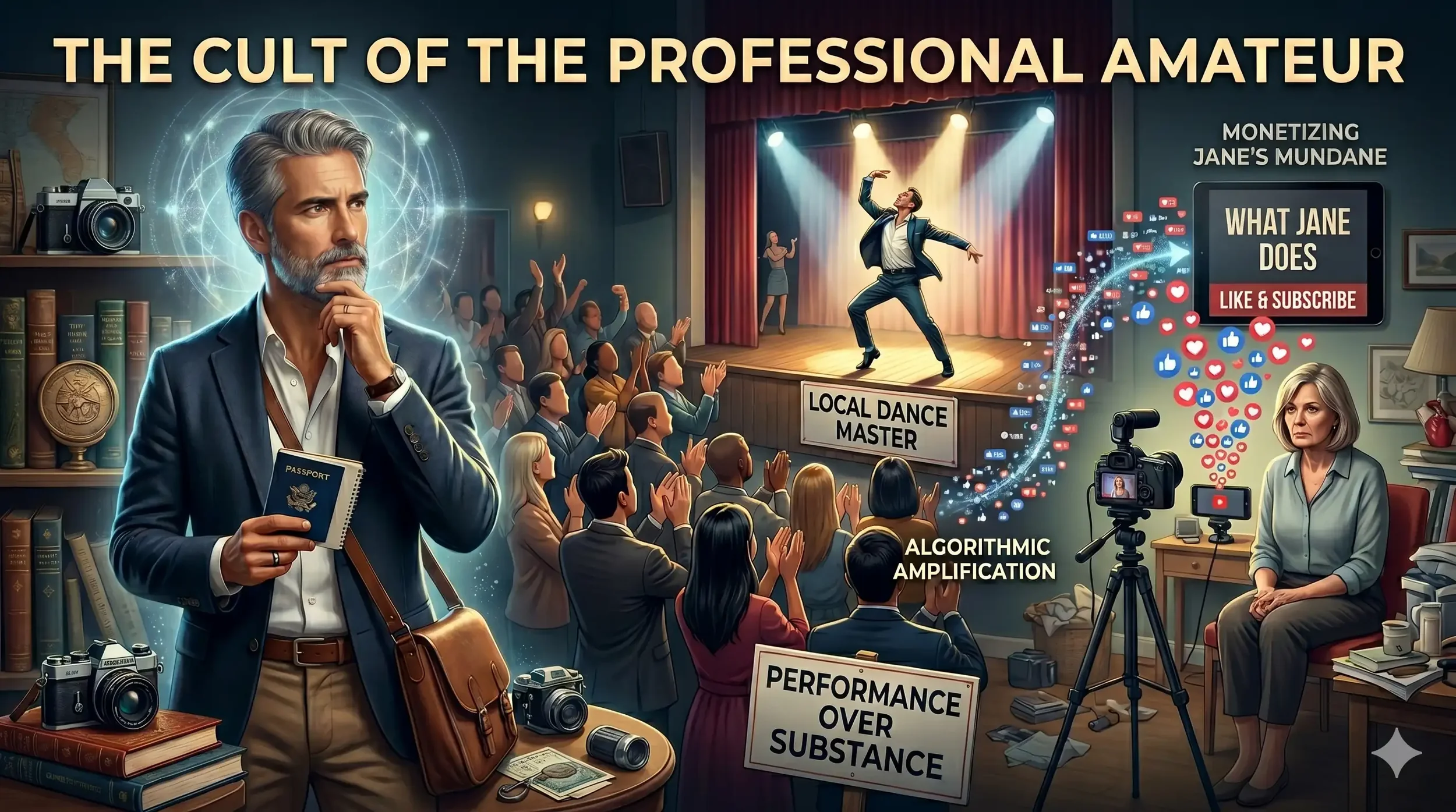
We see this everywhere: the expatriate expert. Someone moves to a new country and, because the local population has no baseline for a specific foreign skill, let’s say, a traditional dance, this person sets up shop.
To the untrained eye, below basic looks like mastery. These practitioners aren't selling excellence; they are selling proximity and convenience. They are the only one here, so they win by default. They haven't earned the stage; they simply occupied the empty space. When you know what true technique looks like, watching this isn't just boring, it’s painful. It’s the monetization of a lack of competition.
2. Audacity Over Ability
Then there is the Confident Charlatan. We’ve all seen him: the teacher or influencer who possesses a massive ego but a suspiciously thin resume. He wins shows not through technical precision, but through sheer volume and theatricality.
In a world of short attention spans, performance of confidence is often mistaken for possession of competence. Most people are looking for a vibe, not a discipline. If someone shouts loud enough that they are the best, the crowd, lacking the nuance to check the facts, simply nods along. It is the triumph of audacity over ability.
3. The Deification of the Mundane
Perhaps the most confusing trend is the rise of the Mundane Idol. You find a channel or a profile with thousands of devoted followers, only to realize the creator isn't actually doing anything. There is no insight, no humor, no skill, just the broadcast of an unremarkable life.
Why is this liked? Because excellence is intimidating. Mastery requires the viewer to think, to feel, or to grow. Mediocrity, however, is safe. People follow these versions of the world because it makes them feel better about their own stagnation. It’s digital sedation, a way to kill time without the burden of being inspired.
The Cost of Having Standards
If you speak five languages, if you’ve seen thirty countries, or if you’ve spent decades honing a craft, you are a high-agency individual. You value substance. You value the extreme sense of humor that only comes from a deep understanding of human nature.
But the modern economy isn't built for you. It’s built for the algorithm, and the algorithm loves the middle of the road. It loves the Professional Amateur because they are easy to digest, easy to replicate, and they don't ask too much of the audience.
Why This Matters to You
You aren't wrong for seeing through the charade. You aren't bitter for noticing that the emperor is naked. You are simply a connoisseur in a world that has forgotten how to taste.
At Unburdora, I believe that the greatest burden you can carry is the suppression of your own standards just to fit inwith the noise. We don’t do basic. I don’t do hollow.
I am looking for the clients who are tired of the shortcuts. The ones who want to speak to a human being with depth, history, and a refusal to settle for the represented quality.
If you’re tired of the dummies being the loudest voices in the room, it’s time to change the room. Let’s talk about substance again.